

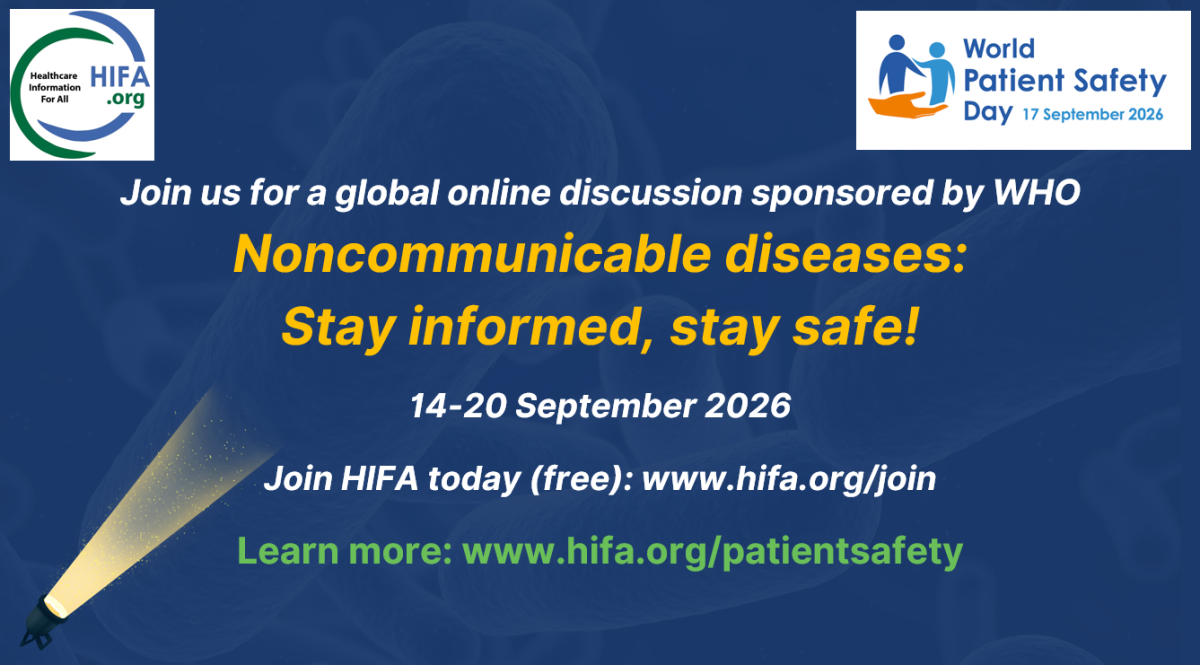
This year's World Patient Safety Day 17 September is on the theme of "Safe care for noncommunicable diseases"
We are grateful to the World Health Organization for sponsoring this HIFA Spotlight on the role of reliable healthcare information for improving patient safety in NCD care. Our aim is to better support patients and health workers to provide safe care and to create safe healthcare systems. For one focused week, we shall leverage the experience and expertise of HIFA forum members to generate insights, visibility, and engagement on this topic. (Learn more about HIFA Spotlights)
We invite everyone to join the HIFA forum to participate in this 7-day in-depth discussion from 14 to 20 September.

Patient safety
Patient safety is defined as 'the absence of preventable harm to a patient and reduction of risk of unnecessary harm associated with health care to an acceptable minimum.' [1]
'Around 1 in every 10 patients is harmed in health care and more than 3 million deaths occur annually due to unsafe care. In low-to-middle income countries, as many as 4 in 100 people die from unsafe care' [1]
'More than 50% of harm (1 in every 20 patients) is preventable; half of this harm is attributed to medications (2,3). Some estimates suggest that as many as 4 in 10 patients are harmed in primary and ambulatory settings, while up to 80% (23.6–85%) of this harm can be avoided. [1]
Common sources of patient harm include:
- Medication errors. Medication-related harm affects 1 out of every 30 patients in health care, with more than a quarter of this harm regarded as severe or life threatening.
- Surgical errors. Harm may occur before, during or after surgery. Most unsafe surgical care arises not from dramatic errors, but from small system failures — missed checks, poor communication, and inadequate monitoring — that accumulate into avoidable harm.
- Health care-associated infections. Hand hygiene, failure of aseptic technique, poor sterilisation of instruments, inadequate environmental cleaning...
- Diagnostic errors. These occur in 5–20% of physician–patient encounters.
- Incorrect treatments.
- Patient misidentification
- Unsafe injection practices
Over two decades, HIFA has consistently highlighted how a failure to meet health workers’ needs, particularly their needs for reliable healthcare information, undermines quality of care and patient safety just as much as technical mistakes do. Over this period, patient-safety thinking has moved from “fix the errors” to “support the people who deliver care.”
'Most of the mistakes that lead to harm do not occur as a result of the practices of one or a group of health and care workers but are rather due to system or process failures that lead these health and care workers to make mistakes.' [1]
Noncommunicable diseases (NCDs)
Noncommunicable diseases (NCDs) include cardiovascular diseases (such as heart attacks and stroke), cancers, chronic respiratory diseases, and diabetes. NCDs account for three-quarters of all deaths worldwide. (Mental health disorders are often grouped alongside NCDs. They share some characteristics of NCDs but have additional aspects that we aim to explore in a future Spotlight.)
'People living with NCDs are at increased risk of harm in health care. This risk is driven by the long-term and complex nature of NCDs, health system challenges such as fragmented care and broader factors that affect access to safe care, such as poverty and discrimination.' [2]
'Safety risks can arise at every stage, from prevention, early detection and diagnosis to treatment and long-term management, across health care settings, homes and communities.' [2]
Reliable healthcare information
HIFA is committed to universal access to reliable healthcare information: a world where every person has access to the information they need to protect their own health and the health of others, and is protected from misinformation.
Every healthcare decision, from self-care in the home through to specialist care in a referral hospital, is dependent on the availability of relevant, reliable healthcare information. Universal access to reliable healthcare information would greatly improve quality of care and patient safety, and would save countless lives every day, especially in low- and middle-income countries. [3]
Reliable information for both health workers and patients reduces errors, improves clinical decision-making, strengthens diagnosis and treatment, and prevents avoidable harm.
NCDs such as diabetes, hypertension, cardiovascular disease, asthma, COPD, and cancer require long-term, complex, and often self-managed care. When health workers and patients lack reliable information, the entire care pathway becomes vulnerable to preventable harm.
NCDs cannot be managed safely without reliable information for both health workers and patients.
Guiding questions
1. What is unsafe care and what is its local and global impact?
2. What are the main causes of unsafe care for people living with NCDs? To what extent is access to reliable healthcare information a determinant of patient safety?
3. What can be done to better understand and improve health systems for safer care for people living with NCDs?
4. How can we better support patients and primary and facility-based health workers to deliver safe care?
Join HIFA today (free) to ensure you are part of the discussion!
References
- WHO: Patient safety
- WHO: World Patient Safety Day
- Godlee F et al. Can we achieve health information for all by 2015?
With thanks to HIFA volunteer working group
- Meena Cherian
- Ashwarthy Sunil
- Charles Vincent
- Diana Zandi (WHO)
Contact: Neil Pakenham-Walsh neil@hifa.org
